
PAINTED TRUCKS OF PAKISTAN
Text and Photos by Umair Ghani
I listen to the upbeat Punjabi bhangra as trucks in many colors whirl pass me I was standing along a tea stall on the Grand Trunk Road near Jehlum. While standing there, conjecturing on my assignment, I just muse on the art of painting especially the art of painting trucks in Pakistan which is unique to our country. Neither do the Indians, nor our neighbors in Afghanistan indulge in this special art.
My fascination stems from Jamal J Elias, a professor of religious studies at the University of Pennsylvania. I read his article and get an e mail from him inspiring me to get on the road and capture the exquisite beauty of design and color of Bedford trucks in Pakistan. “You see them everywhere,” Elias wrote in his article, “But a lot of people don’t see them. One day I started staring at them, very carefully. And I started to see there was some order to the madness.” Elias took six years to compile his monumental work for his forthcoming book “On Wings of Diesel”, and it is still in continuation. I traveled some 5000 km in three months from Karachi to Khunjrab Pass traversing through deserts, plains, passes and awesome mountain landscapes along Karakoram Highway. I met many interesting people, roadside artists (Street Picassos I call them) and many unforgettable experiences in my quest for unique vehicle decorative art in Pakistan. During all that wonderful period of exploration, I had but one consistent inspiration from that genie of Pakistan truck art — Jamal J Elias
Sipping morning tea from a tiny china clay cup in a roadside truck drivers’ tavern on the banks of river Indus, I looked at the long stretch of Karakoram Highway winding into the distance. It was only a night before when I reached Bisham from Lahore. I have been on the road for many days without rest pursuing truck caravans bound for Sost [last Pakistani village on Pak-China border]. Morning sun shone brightly over the mud roof of driver’s hotel a few kilometers ahead of Bisham. We sat on huge charpoys, sipped more tea as Sada Khan talked about his magnificent red Bedford parked outside. “This truck is my bride. That’s why most of them are painted in red. I spent most part of my life with it than at my home with parents and family. Like a newly wed bride it should look beautiful, enticing and alluring.” He narrated this with the magic touch of an ancient story teller. Soon, the tantalizing channa dal and parathas arrive and breakfast begins in a formal manner. Sada Khan laid his back on the many colored blankets piled on the charpoys and continued his tale, “I fell in love with truck decorations in Peshawar, where I was a helper boy at truck stations decades ago. I know that an aesthetically decorated truck can make you jealous, envious at best and you cherish the dream to outclass others by more eloquent designs and patterns.” A normal sized Bedford truck takes three to four hundred thousand rupees to be painted and decorated in style, a sum that amounts to two years’ salary of an average truck driver.

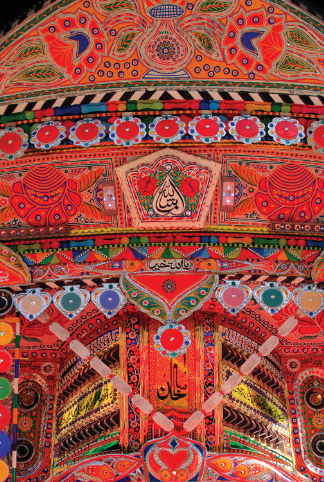

Yet, many of them spend whatever fortunes they have on truck paintings. It may take one to two months for the truck to get ready for the road. Truck workshops in Karachi, Ghotki, D.G. Khan, Peshawar, Taxila, Rawalpindi and Lahore are centers of decorative painting industry for this kind of vehicle art. To some extent it is done in Afghanistan, India, Indonesia, Malaysia and Philippines as well but Pakistan has a unique style of color and designs that is clearly distinguishable. It is based on a whole set of religious, patriotic and cultural ideology. The fascinating diversity of images ranges from secular to religious themes. Famous actresses and cricketers appear more frequently on wooden planks.
Winds of cultural change though have replaced leaders, martyrs and other celebrities with missiles and new age heroes like Dr Abdul Qadir Khan as country stepped into the Nuclear Club in1996. “Patriotic Billboards” as many Westerners label these vehicles, the trucks carry a huge number of religious signs and slogans as well. Images of Ka’aba and Madina appear mostly on the upper front with names of Allah and the Holy Prophet. Verses from Holy Quran are either painted or hung in the form of plastic cut outs or metal pieces. Images of birds and animals, most notably peacocks, pigeons, lions and tigers are drawn on the side panels. The ever present figure of Ayub Khan behind many trucks in NWFP and Balochistan has something to do with a mix of some patriotism and nostalgia of the bygone days In a country with poor road infrastructure and almost non extant railroad system for mobilization on a mass scale, Ayub’s son, from 1962 to 1969 came forward as the country’s sole Bedford dealer and made sure that Bedfords were the only trucks imported into the country. Locally manufactured trucks were nowhere in the competition and when local artists created breathtaking masterpieces out of Bedfords they swept the market like a storm. J.M. Kenoyer, a renowned scholar of Pakistani culture comments, “The paint jobs identify competing ethnic groups. You can look at a truck and tell exactly what region it comes from and what ethnic group the driver belongs to.”
Through my multiple interactions with truck drivers I came to know that truck painting for them was a labor of love, “and love makes you suffer”, whispered Badshah in a dingy tea stall in the outskirts of Multan. Truck drivers don’t spend much money on their families and houses. They view trucks as a deity which brings them income, joy and freedom of the road. It’s kind of Bhagwan for us”, Badshah displayed his tea and naswar coated teeth and straightened thick moustache with the thumb and first finger of his free hand. I recalled an article where Durriya Kazi, head of the department of visual studies at the University of Karachi and an encyclopedia of Pakistani truck-decoration quoted such instances, “I remember one driver who told me that he put his life and livelihood into the truck. If he didn’t honor it with the proper paint job, he would feel he was being ungrateful.” This sense of devotion acts as a remarkable bond that keeps the trucker and the truck chained together. For a truck driver, his machine is the life’s whole sphere. He scarcely looks beyond that. “We don’t have to”, laughed Badshah, “and why should we when we feel protected and enormously proud in our beautiful paradise.” Charas, naswar, and tobacco are among some of the pleasures these truckers have in their rugged routines. The glorious art work provides an escape from the monotony of life. Music is another pre-requisite of this nomadic lifestyle. Truckers don’t dance, not even sing but are fond of folk tunes and songs that include regional flare. Atta Ullah Khan Eesakhailvi, Allah Ditta Loonay Wala and Zarsanga are among most cherished singers. Multicolored laces hang from stereos and speakers covered in beads and plastic decorative items make truck interiors pompously ornamental.
Booming truck painting industry despite all its magnitude and impact may not be a lucrative vocation for the people who work in it. Street Picassos [truck painters] are mostly underpaid. Many ‘Ustads’ and their apprentices commonly called ‘chotas’ create magnum opus out of a common Bedford for small amounts and scanty privileges. “Big chunk of the money goes to workshop owner”, said Hajji in a typical Lahori workshop famous for plastic and metal work. “This art is a complete exhibition on wheels which involves arduous labor and a careful placement of each piece of colored plastic, every stroke of paint brush and carving and engraving on the panels and sides”, he explains amid chugging of heavy engines and noisy rattle of metal plates. Though well known and respected for their artistic skills, many of them are dissatisfied with marginal wages they earn from their creative art. They wish their kids to join school and get educated for better jobs.

