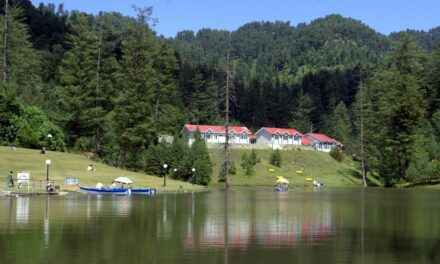
Khanpur Lake is located on the Haripur/Taxila road about 48 kms from Islamabad. With its blue, green water and peaceful environs, Khanpur Lake is an ideal spot for a day trip/picnic if you live in Islamabad. The dam and the rest house are located on the South side of the lake and are not accessible to the general public. WAPDA rest house which sits atop a tiny hill beside the dam looks more like a castle than a rest house and provides a spectacular view of the lake. The lake and the surrounding areas are pretty clean except for the West side of the lake which is open to general public and is littered with trash. Evenings are pleasant at Khanpur Lake even in the scorching heat of the summer.


In March 2008, my husband and I decided to stopover for a day at Khanpur Lake while traveling further north. We started off from Lahore at noon and traveling via motorway [M2] reached Khanpur at around 4 pm. After settling down in our room at the rest house, we ordered some tea and fries. The rest house has one caretaker who also serves as the cook. I took out my camera and started clicking. The color of the lake seemed to shift between emerald green and turquoise as the light changed and just looking at the lake was a treat for the eyes. I was enjoying the silence and the beauty around me when the caretaker called for tea. After washing down some very oily fries with tea, we decided to explore the surrounding area. On previous visits to Khanpur Lake, we were always intrigued by a structure that looked like a mosque/gurdwara on the North side of the lake. This time we decided to find out what it was so we drove around the lake through a village and hit a dirt track that led us to this structure. It was an old, abandoned mosque with some architectural features that resembled those of a Gurdwara. There was a lone date palm nearby and some smaller structures in ruins. It was late in the evening and we thought it best not to go inside the mosque at that time but decided to return early next morning. I spent the rest of the evening taking pictures of the spectacular sunset that cast its golden glow on the serene water of the lake and made it shimmer like a jewel. A fisherman sitting at one edge of his tiny boat seemed like he would topple over any second but he kept rowing with as much ease as we sat at the bank watching him. He had one oar that he kept moving left and right, almost rhythmically but it broke the silence around us softly and we realized that it was getting dark, so we left.
As we approached the rest house, the smell of freshly fried fish greeted and beckoned us straight to the dining hall. Though it was nothing as fancy as the spicy, fried fish accompanied by the delicious sweet and sour chutney from Bashir Dar-ul-Mahi back in Lahore, we still enjoyed eating it, comforted by the fact that this fish came from Khanpur lake which is one of the very few manmade lakes in Pakistan that are free of sewage from the city or industrial pollutants and other toxins. And so, we enjoyed dinner for an hour, forty-five minutes of which were spent carefully hunting for teeny tiny fish bones, some of which still made way down my food pipe.
We went out for a walk after dinner but had to cut it short and return to our room because the air was pretty chilly and we weren’t dressed for such weather. We went to sleep disturbed by the howling of jackals that roam in the woods around the lake. Next morning, we woke up early and drove back to the mosque. As I was busy admiring the soft, morning light hitting the mosque while setting up my tripod to take pictures, my husband went off to talk to a villager who was herding his cows and looking at us suspiciously. On inquiring about the mosque, the villager told him that the mosque was over two hundred years old and was built by the Rajas of Khanpur who had also built a haveli nearby with a hundred and one rooms. Wapda took over the land for the purpose of building a dam and the Rajas sold the haveli to Wapda but later they tried to take it over again. As a result of the dispute, the haveli was destroyed and what is left of it is only a small wall of a room, part of which stands above the lake water to remind us of its ill fate. According to the villager, some of the recordings of the popular television serial “Waris” also took place in that haveli.
The mosque, however, still stands, although part of it has collapsed. Only Eid prayers are offered in the mosque and for the rest of the year, it remains abandoned. The mosque has been painted with unusually bright colors like red and blue that give it a unique character. The dome resembles that of a gurdwara and at first, we thought maybe it was a gurdwara taken over by the Muslims but later while driving back from Khanpur, we noticed that all mosques in the Khanpur/Taxila area had similar domes, probably because of the strong influence of Nankana Sahib that is only a few kilometers from Khanpur.
We left Khanpur with heavy hearts thinking that this mosque was yet another addition to our long list of historical buildings in Pakistan that need to be preserved. Who will preserve this tiny mosque in a country where historical and architectural giants like the Rohtas Fort and Shahi Qila that are on the World Heritage list lie in shambles?
Shazia Rubab Hussain
Disclaimer: The writer does not take any responsibility as to the accuracy of historical information regarding the mosque in this article. The information was collected from local villagers.