By: Samman Ehsan
The Snow Leopard is rare, endangered, secretive and up against a harsh environment. Snow Leopard – the magnificent, big cat is usually found in high mountains (between 3,000 and 5,400 metres above sea level). In a climate which is cold and dry and the mountain slopes sparsely vegetated with grasses and small shrubs is the realm of this big cat.
Snow Leopards live in the high rugged mountains of Central Asia and the range extends to twelve countries: Afghanistan, Bhutan, China, India, Kazakhstan, the Kyrgyz Republic, Mongolia, Nepal, Pakistan, Russia, Tajikistan and Uzbekistan. In Pakistan Snow Leopard was first photographed in Chitral in the wild around 30 years ago.
Its habitat is spread over an area of 81,000 km, in the Hindu Kush Mountains (close to the Afghan border) in the Himalayas and Karakoram mountain ranges all in the far north of the country. In terms of administrative region, the species inhabits all five districts of the North, in Chitral, Dir, Swat and Kohistan districts of the North West Frontier Province, and in Muzaffarabad district in Azad Jammu and Kashmir. Sadly, less than seven percent of this area is reserved for wildlife.

WWF’s wildlife research is focusing on this most shy, elusive and solitary big cat – the Snow Leopard, along the Afghanistan-Pakistan border. Estimates predict that there are only 3,500-7,000 snow leopards now remaining and this population is in decline in many parts of their range. As for Pakistan, recent surveys undertaken in the Baltistan district of the Northern Areas reveal an estimate of 90-120 animals in that district and 300-420 animals throughout Pakistan. Research by WWF, some of which will be concentrated in the Kingdom of Bhutan, includes gathering ecological data and habitat status on Snow Leopard populations and in some other areas using GPS to track the leopards’ range and movements. Named Bayad-e-kohsar, a female snow leopard was captured and collared in Chitral Gol National Park, in northern Pakistan. In first study of its kind, the 35 kg (78 pound) leopard was fitted with a GPS-Satellite collar that will provide researchers with an unprecedented amount of precise data on movements and habitat of this big cat. The collar contains a GPS which will calculate the cat’s exact position several times each day and then uplink the data via the Argos satellite system and back to the researchers by email.
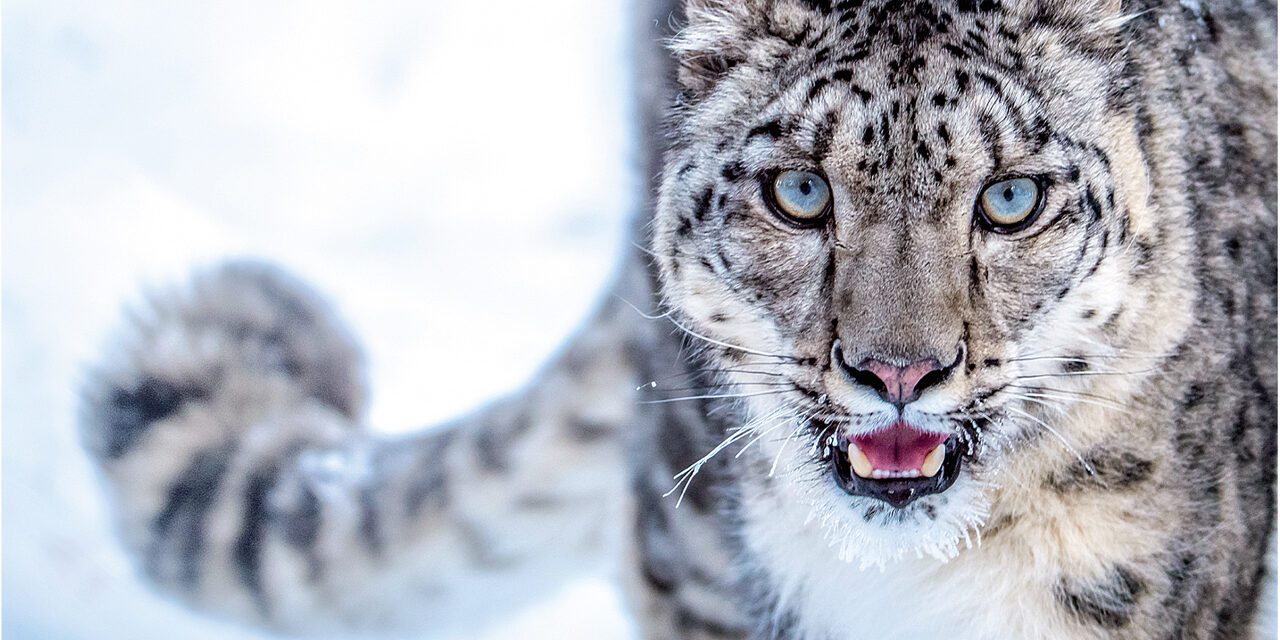
The smoky-gray snow leopard weighs about 35-55 kg (female: 35-40 kg, male: 45-55), measures about 1.8-2.3 m in length from head to tail and stands 60 cm at its shoulder. Snow leopards are characterized by a short, broad muzzle, short forelimbs and long hind limbs that provide agility in steep and rugged terrain. Their body fur is tinged with yellow and prominent dark grayish-black rosettes and spots. The characteristic long tail aids in balancing on cliffs and rugged places. Also, snow leopards wrap their body and face with the tail for comfort and warmth against the cold. Large paws perhaps help them walk better on snow.

The long-term future of the Snow Leopard in Pakistan is under threat, mainly from retaliatory killings by farmers and poaching for pelts and other body parts. There is a growing market for the bones, skin and organs of Snow leopard for traditional Asian medicine. Loss of prey and of natural habitat is also affecting the species. Villagers with growing domestic livestock herds have encroached into the Snow Leopard habitat, driving away the native preys. According to a report by Traffic, marmots – important prey species for Snow Leopards – were regularly observed during market surveys in Pakistan, in 2002, and conservationists have raised concerns about the unmanaged exploitation of marmots in Pakistan. The same report states that according to furriers in Karachi, marmot skins are in great demand in Europe and the Russian Federation and the majority is collected from Pakistan which is then exported. One marmot skin is worth around USD10, depending on the quality. Trophy hunting of ungulates may be contributing to a diminution of Snow Leopard prey in northern Pakistan.
Then the villagers in the Snow leopard range of Pakistan depend on their flocks of livestock. Snow leopards are turning to the domestic preys, which are kept in roughly built corrals and stone pen that can easily be penetrated by Snow leopards. The herders have little choice but to resort to retaliatory killing.
Snow Leopard Project of WWF-Pakistan is dedicated to enhancing the existing information base about the Snow leopard and its conservation through community participation. The key to Snow leopard conservation lies in the proper demarcation of the actual Snow leopard habitat, and making the communities living in the Snow leopard range its key protectors.
WWF-Pakistan in collaboration with the International Snow Leopard Trust (ISLT) has initiated a Snow Leopard Project to save this flagship and endangered species. The project introduced alternate livelihood measures for the local communities in exchange for reducing hunting of the Snow Leopard. The Swiss Government is providing additional technical and financial support to a project named ‘Income generation for Snow Leopard Conservation’. As part of creating alternative income generation opportunities, 600 cloth napkins were prepared by locals in Kuju in 2006 and sold in the US to make-up for the losses to their livestock by Snow Leopards. Training in animal husbandry, fodder preservation and enterprise development were conducted in Kuju and Parsan, the two model sites of the Snow Leopard project. Rufford Grants Program has also approved a project proposal titled ‘Community-based Snow Leopard Conservation through improved animal husbandry in Chitral’.